Six of Pentacles
↑ Upright🔮 Today's Interpretation
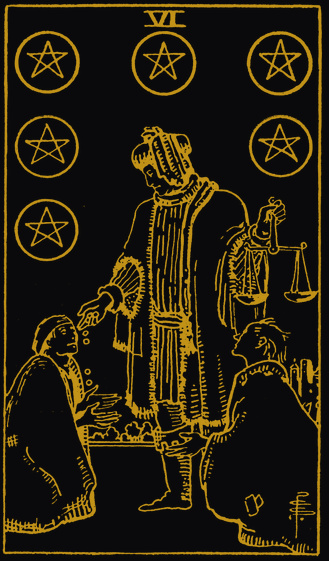
Start with the image itself: in the Rider-Waite-Smith deck, the Six of Pentacles presents a well-dressed merchant holding a balanced scale in one hand while dispensing coins with the other to two kneeling figures. This card belongs to the Minor Arcana, specifically the suit of Pentacles, which corresponds to the element of Earth. In tarot numerology, the number six represents harmony, equilibrium, and the resolution of conflict; it is the stabilizing force that comes after the crisis of the five. Because this card is drawn Upright, we are looking at the healthy expression of this energy: a balanced exchange where resources flow freely. The merchant is not hoarding, nor are the recipients being forced to take; there is a transaction of generosity here. The scales in the merchant’s hand are crucial; they remind us that true generosity often involves a fair weighing of needs and resources, ensuring that the help provided is appropriate and sustainable, rather than overwhelming or indebted.
Since the card is upright, we can explore the deeper traditional layers that distinguish this specific card from other cards of giving. In the Thoth deck, Aleister Crowley titled this position "Success," emphasizing the material prosperity that comes from fair play. Historically, the esoteric tradition assigns this card to the Moon in Taurus, a placement where the Moon is said to be "exalted," meaning it operates at its highest potential. The Moon governs emotion and intuition, while Taurus is the most stable and abundant earth sign; together, they suggest that material security brings emotional peace. This isn't just about money changing hands; it is about the circulation of abundance. The card teaches that wealth is not static. When you hold the scales, you are managing flow. If you are in the position of the merchant, the card asks if you are giving from a place of surplus rather than obligation. If you are in the position of the recipients, it encourages you to accept help without shame, recognizing that receiving is also an active part of the cycle of exchange. The upright position validates the idea that asking for help and providing it are both acts of strength, not weakness.