The Hanged Man
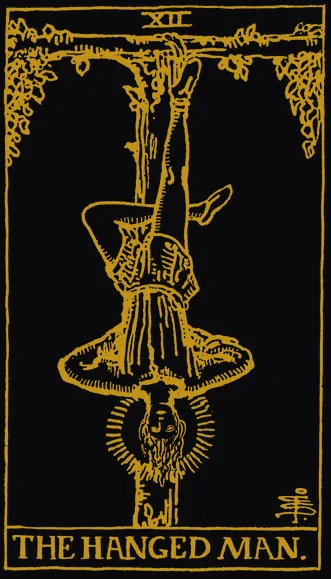
The Hanged Man on August 22, 2026, under a waxing gibbous moon at 68% illumination. This reading is free to read in full — no account needed.
Keywords: Pause, surrender, letting go, new perspectives
🔮 How The Hanged Man meets today's sky
Today you have drawn The Hanged Man, the twelfth card of the Major Arcana, which is the first half of the tarot deck containing the archetypal journeys of the soul rather than the day-to-day events of the Minor Arcana. In the Rider-Waite-Smith imagery, this card depicts a man suspended upside down from a living green tree, his left leg bent at a right angle and crossed behind his right knee to form a tetrad—the number four, symbolizing stability and material manifestation—while his hands are bound behind his back and a radiant halo surrounds his head. This specific orientation is upright, which signifies a willing surrender and a shift in perspective that comes from pausing action, whereas a reversed Hanged Man would suggest being stuck in victimhood, martyrdom, or refusing to see the lesson despite clear signs to let go. The card traditionally represents the suspension of ego-driven effort in favor of intuitive understanding, teaching us that sometimes the only way forward is to stop pushing and allow a new viewpoint to emerge from stillness.
To understand this card more deeply, we can look beyond the standard Rider-Waite symbolism into other esoteric traditions. The Golden Dawn assigned this card to the Hebrew letter Mem, which means "water," connecting it to the element of Water, which governs emotion and intuition. This aligns with the RWS image’s lush background and the submerged feeling of the figure, suggesting a dissolution of the self into a larger whole. In the Thoth deck, Aleister Crowley depicts this as the drowned god Osiris, emphasizing the theme of mystical death and the sacrifice of the old identity to birth a new consciousness. Meanwhile, the older Tarot de Marseille version, known as Le Pendu, retains some of its historical roots in the "shame paintings" of Renaissance Italy, where traitors were depicted upside down; thus, even in its most spiritual interpretations, there remains an undercurrent of reversal—what is lost by force is gained by choice, and what seems like a penalty becomes a privilege through conscious acceptance.
Turning to the sky above us on August 22, 2026, we are in the Waxing Gibbous moon phase, which occurs just before the Full Moon, a time dedicated to refining our intentions and adjusting our course based on recent feedback rather than launching new initiatives. The Sun is at 28.57° Leo, placing it in the final degrees of fire energy, indicating a focus on self-expression that feels urgent or nearly complete, while Mars in Cancer suggests your drive is fueled by emotional security and home life. Most notably, we have three outer planets retrograde: Saturn, Neptune, and Pluto. Retrograde motion is an optical illusion caused by Earth overtaking a slower-moving planet in its orbit; astrologically, these periods invite us to turn our attention inward to review, reorganize, and heal rather than to push aggressively outward into the world.
When we combine The Hanged Man with this celestial weather, the message becomes remarkably clear: you are being asked to align your voluntary pause (The Hanged Man) with the current planetary directive to look inward during these retrograde periods. The Sun’s late Leo position might make you feel a strong desire for recognition or dramatic resolution, but Mars in Cancer and the triple retrograde suggest that forcing this outcome will only lead to friction. Instead of trying to "break through" obstacles right now, use this suspension period to let go of how you think things *should* look (the upright view) and observe them from a different angle. The Hanged Man’s halo reminds us that this stillness is not passive emptiness but active illumination; let the retrogrades settle old accounts while you hold your new perspective without judgment.
For your teaching takeaway today, remember that the Major Arcana cards represent major life lessons or karmic themes, while the Minor Arcana (the suits of Wands, Cups, Swords, and Pentacles) handle the daily details. Understanding this distinction helps prevent anxiety; when you draw a Major Arcana card like The Hanged Man during minor daily stresses, it is often telling you that this small event is part of a larger, necessary shift in your worldview, not just a random inconvenience. Use this day to practice "conscious waiting"—not the anxious waiting of expecting something to happen, but the active, observant pause of letting reality reveal itself on its own terms.